Evergrande and the Real Estate Bubble

On August 20th, at the Shenzhen Intermediate People’s Court (深圳市中级人民法), Xu Jiayin (许家印), founder and chairman of the Evergrande Group, pleaded guilty to charges of embezzlement and corporate bribery. Fifty-six other defendants, including his own sons, faced similar allegations. With the drop of a gavel, six years of intense controversy around the collapse of China’s largest property developer were finally put to rest.
With sentences ranging from 1 to 18 years in prison, much of Evergrande’s executive directorate is headed to jail. Xu Jiayin, China’s onetime richest man, suffered the heaviest blow of all: life imprisonment and the confiscation of all his assets. Additionally, the court ordered the immediate reimbursement of the affected families and the payment of large fines to the state.
More than anything else, the fate of Xu and his corporation was determined by political decisions (or lack thereof). It was government policy, during Reform and Opening, that allowed the housing market to exist. Later, it was the lack of government oversight that enabled and promoted Xu’s business model. Finally, in the post-COVID era, it was the government, with its readjustment strategies, that ended up undermining and annihilating it.
Studying the history of Xu Jiayin and his financial empire is particularly important to understanding recent changes in the Chinese economy. Evergrande’s rise and demise reflect Beijing’s evolving role in the Chinese economy, making the company a unique case study through which to examine the trajectory of Chinese economic policy and where it might be headed in the years ahead.
The first step is to understand that Xu Jiayin’s public image wasn’t always as negative. Back in 2010, a feature in the People’s Daily described his meteoric rise with overflowing praise, labeling the entrepreneur as one of the quintessential examples of the “modern Chinese man”. “Xu Jiayin: from worker to billionaire” (许家印:从打工仔到首富), makes his personal story into the reincarnation of the values and ideals behind the “Chinese dream”. From humble beginnings, Xu rose to become wealthy and successful, all while contributing to the growth and prosperity of his own country.
Born in rural Henan during the Great Leap Forward, Xu Jiayin’s early days were marked by pain and precarity. At the age of one, he lost his mother to sepsis and was taken in by his grandmother, who would raise him to adulthood. Having completed high school at the height of the Cultural Revolution, Xu was sent to the fields to work. Two years later, in 1978, he finally enrolled at the Wuhan Iron and Steel University.
After graduation, as it was custom in the command economy of the time, Xu was assigned to a danwei 单位 at the Wuyang Iron and Steel Company. For more than a decade he stayed on, climbing up to the post of director. Yet, at the age of 34, Xu decided to abandon his state job. With no more than RMB 20,000 in his pocket, together with his wife (whom he had met at the factory), he moved to Shenzhen, the most successful of the Special Economic Zones experiments. There, he would start from scratch.
His time in Shenzhen would not last long, however. In 1998, Xu once again packed his bags and moved to Guangzhou. Earlier that year, the Chinese Communist Party had announced the liberalization of real estate. The introduction of market mechanisms would, according to the State Council (国发 (1998) 23号), “accelerate the construction of residential buildings”, quickly becoming “a new driver of growth”. Xu saw this as a unique opportunity to launch a business of his own. In his new home, he founded Evergrande Group, a real estate company.

Xu’s bet was a successful one. The economic growth of the late 1990s and 2000s was unprecedented. With foreign investment pouring into China’s coastal cities and a rising domestic market, the country entered a “construction craze”. From infrastructure to housing, China became a large, open-air construction site. A 2011 report submitted to the National People’s Congress states that, between 1998 and 2010, urban areas saw the average per-person living area increase from 18.7m2 to 31.6m2.
Yet, Evergrande’s success was far from guaranteed. The China of the 1990s was a country facing rapid, drastic change. In such a volatile, fast-paced environment, privilege and political connections came a long way. The economic frustration of the late 1980s came partly as a result of the inequality generated by the first rounds of reform. Those with contacts within the Party-state knew in advance where, when, and how to take advantage of this change. Xu Jiayin was neither privileged nor well-connected. His success was a matter of method.
His business model cannot be explained without first understanding the basics of the Chinese real estate market. First, the notion of 土地财政 (tudi caizheng) or “land finance”. In China, land is owned by the state and, as such, it can neither be bought or sold. Private individuals or corporations can, however, acquire a “right to use” permit from local governments. For up to 70 years, “tenants” can then use the land as they see fit.
Evergrande succeeds precisely as a result of the involvement of local governments in land acquisition. While the 1990s and 2000s were an era of rapid growth, for local officials, it was also a time of unprecedented economic and political pressure. Though they were granted a greater degree of freedom in conducting policy, their responsibilities only grew more demanding. China’s modernization project required infrastructure of all kinds, from transportation, to schools, and hospitals. At the local level, expenses quickly increased. Beijing did little to provide relief. The overbearing tax transfers to the center continued uninterrupted, forcing officials to seek remedy in other “sources”.
And revenue they found. Exploiting the land acquisition process, a scheme emerged. Local officials sold land rights to developers and used the resulting revenue to finance infrastructure projects. Those improvements then raised surrounding land values, allowing officials to sell additional land at higher prices and repeat the cycle. The system would work as long as prices kept rising. Local governments obtained much-wanted financial relief, while developers and tenants saw the value of their land skyrocket. In this transaction, no actor had any reason to interrupt the scheme, giving way to China’s real estate bubble. In 2021 alone, the sale of land rights brought over RMB 8,700 billion into the pockets of local governments, roughly equal to a third of all of China’s public revenues. Thirteen years earlier, in 2008, it had amounted to only one sixth.
Political incentives contributed to this loop. At the height of reform, local officials were evaluated on rigid growth metrics. Promotion depended on whether territorial governments could execute central directives and produce measurable prosperity on the ground. Construction appeared a safe bet. Mayors who sold more permits, attracted more developers, and, with them, jobs and growth. A 2025 Yuekai Securities report states that, at the local level:
“政绩考核机制才是问题的关键,激励机制决定行为,引发了地方政府隐性债务和“土地财政”等连锁反应。如果没有分税制,只要存在 GDP 考核,仍会产生资金饥渴和不”
“The performance assessment mechanism lies at the heart of the issue; incentives drive behavior, triggering a chain reaction that includes local government hidden debt and land finance [...] As long as GDP-based assessments remain in place, “revenue hunger” will persist.”
Xu Jiayin demonstrated a unique ability to exploit the scheme in his favor. The People’s Daily feature mentioned earlier in this article described Evergrande’s method as the following:
用最少的钱那更多的地,发展的时间持续更长
“Acquire more land at the lowest possible cost and sustain development over a long period.”
In practice, the model went as follows. First, Evergrande would use bank loans to buy land rights. Then, the project, though still far from finished, would be quickly placed on the market. Finally, the revenue would be invested into even more land-permits to continue the cycle. This system allowed Evergrande to own, at its apex, 565 million m2 of development land and real estate projects. At the same time, as one might guess from this scheme, Evergrande began to quickly accumulate debt. The company’s foundations began to shake in December 2016, much earlier than its official liquidation. In Beijing, at the annual Central Economic Work Conference, the Party released what was, effectively, a first warning to real estate developers like Xu Jiayin.
房子是用来住的,不是用来炒的。
“Homes are made to live in, not to speculate.”
The final document of the Central Economic Work Conference signaled a historic shift in Party policy. Until then, China had prioritized rapid growth, turning a blind eye to business malpractice in key economic sectors. That was no longer the case. Xi Jinping, and many with him, believed that the excesses of Reform might come back to hurt China. It is unclear whether developers like Evergrande took the statement seriously or whether they moved to align closer to government policy. Judging from the final result, it is, however, likely that they overplayed their hand. Firms like Evergrande thought of themselves as “too big to fail”. The real estate market had been one of the main drivers of growth since 1998, providing companies with significant leverage in negotiations with the government. But, again, times had changed, and so did Beijing’s priorities.
In August 2020, Chinese authorities released an internal document proposing a sharp revision of property development financing regulations. The changes, coming after four years of government crackdown on real estate speculation, were shared that same month with the executives of twelve major firms. According to the information collected by Caixin, Beijing stated that the sector’s finances would henceforth be evaluated on the basis of three red lines.
Liability to asset ratio (excluding presales) ≤ 70%
Net debt to equity ratio of ≤ 100%
Cash holdings at least equal to short-term debt
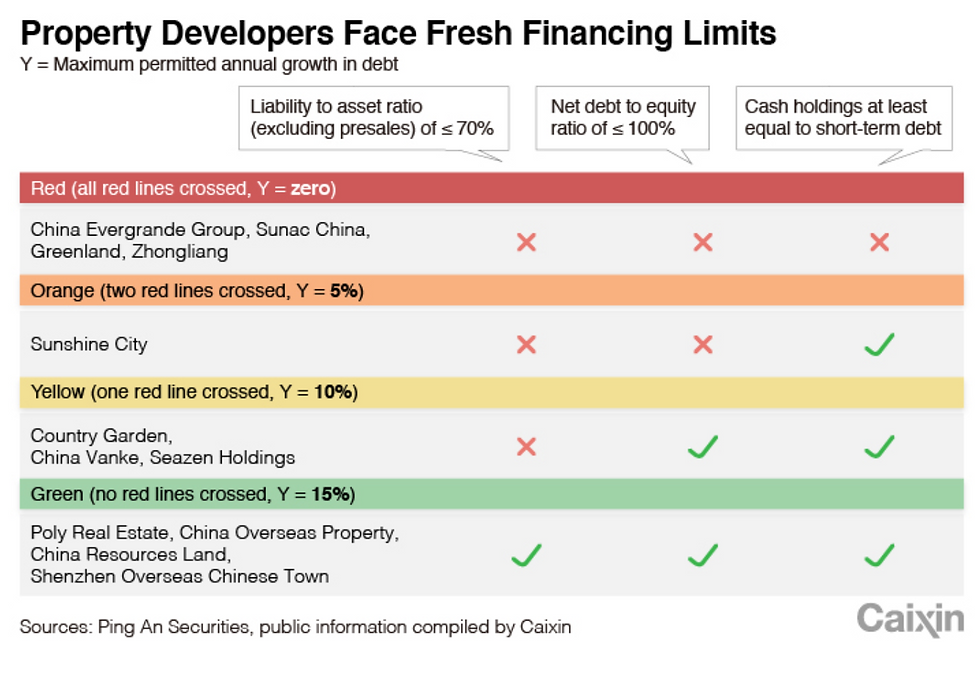
Crossing even just one red line would mean having to redirect all efforts towards debt repayment. Evergrande Group being in violation of all three, it was forced to immediately halt construction. By the spring of 2021, the company had already entered a full-blown liquidity crisis. That summer, Xu Jiayin resigned as Chairman and, in September, Evergrande announced it was postponing all customer reimbursements.
With this document, Beijing effectively dealt a fatal blow to the Chinese real estate market. In the middle of a global pandemic, while other governments were busy subsidizing the real estate market, China chose to burst its own bubble instead. The timing suggests a certain sense of urgency in Zhongnanhai about the potential consequences of letting firms like Evergrande continue to artificially pump this sector. Political considerations must have also been at the center of the conversation. Housing had long been a principal investment good for countless Chinese families. Seeking additional revenue sources, entire households pledged life-worths of savings to projects like Evergrande’s. Bursting the bubble would thus mean bearing the political consequences of decades of malpractice.
In 2022, customers began to raise their voice. Through letters, petitions, and public demonstrations, they demanded the immediate resumption of all construction and the fulfillment of Evergrande’s contracts. Alternatively, they threatened, they would no longer pay their loans. Having this become, as expected, a wholly political affair, the center decided to step in. Local governments were flooded with complaints and could not hold out on their own. Additionally, in the eyes of the concerned public, the Party had no choice but to compensate for ignoring decades of malpractice. And respond they did.

Beijing decided to save the construction sites. Government authorities would begin to examine projects on an individual basis, to determine whether to resume or permanently halt construction. Those receiving approval would continue to receive financing from banks and be, in time, delivered to the original customers. Corporations, on the other hand, received a much harsher treatment. If insolvent, firms like Evergrande would be forced to liquidate without margin for negotiations.
The decision to “save” the construction sites helped placate a potentially explosive crisis for Beijing. In 2025, the government announced the completion and delivery of over 7.5 million apartments involved in the real estate crash. The center acted with the clear intent of defusing tensions before all else. Had the government opted for a more rigid approach, customers, from buyers to suppliers, would have had nowhere to turn but Beijing to express their grievances. One might even say that the 2020 halt was decided on the basis of these same considerations. Without a clear stop six years ago, the bubble could have perhaps outgrown, both politically and economically, any measure to counter or temper its effects.
At the same time, the economic fallout of the real estate crash is projected to be significant. Local governments, whose financing model had become inextricably linked to the incremental sale of land rights to developers, lost their primary source of revenue. This is likely to worsen the local debt crisis in the future. Real estate investment also suffered. In the first seven months of 2026, the total figure was down 19.2% compared to the previous year, which had itself marked a significant decline from the past. There are other effects. In July 2026, even as industrial output grew by 4.5%, household consumption continued to stagnate, with a mere +0.6%. Overall, the economy appears to be entering a cooling phase, markedly under the set target of 5%, in part as a result of the real estate crash.
Alessandro B. Carelli - 王硕
The Beijing Notebook - 北京笔记


Commenti